What Happens When You Treat Your Job Search Like a Pipeline
Most job searches feel reactive because they are managed as scattered tasks. Treating your job search like a pipeline creates clarity, momentum, and better decisions.
Many job searches feel harder than they need to.
Not because of a lack of effort.
Because everything is being managed as separate tasks.
Apply here.
Reply there.
Follow up later.
Check email again.
It becomes reactive very quickly.
If you missed the previous article, read
Why Spreadsheets Break Down for Job Searching.
The problem with task-by-task searching
Most people manage their search one action at a time.
They focus on whatever feels urgent:
- a new job posting
- an unread recruiter email
- an interview request
- a follow-up they almost forgot
That creates movement, but not always progress.
Without a clear structure, it becomes difficult to know:
- which roles are active
- which are stalled
- which need attention today
What a pipeline changes
A pipeline gives every opportunity a visible stage.
Instead of a pile of tasks, you have a process.
Typical stages might include:
- applied
- recruiter screen
- hiring manager interview
- final round
- offer
- closed
Now every role has context.
You can instantly see where things stand.
If you want to understand the foundation first, read
What a Good Job Search System Actually Looks Like.
You stop wondering what is happening
This is the biggest shift.
Instead of asking:
- Did I already apply there?
- Who needs a reply?
- Which company said they would get back to me?
- What should I do next?
You already know.
The pipeline answers those questions for you.
Momentum becomes easier to maintain
When your search is visible, it is easier to keep moving.
You can quickly spot:
- roles waiting too long
- follow-ups that are due
- interviews approaching
- opportunities losing momentum
This helps you act earlier instead of reacting late.
If follow-ups are something you struggle with, revisit
Not Following Up Is a Job Search Mistake.
Decisions become clearer
A pipeline also improves judgment.
When everything is scattered, each opportunity can feel equally important.
When everything is visible, patterns appear.
You can see:
- which companies move quickly
- where you are getting traction
- which roles are stuck
- where to focus energy next
That makes decision-making easier.
Less stress, more control
Many people think organisation is just about neatness.
It is not.
It reduces stress.
When your job search lives in your head, it creates constant mental load.
When it lives in a system, you can think more clearly and perform better.
Bringing everything together
A strong job search is not just about applying.
It is about managing momentum.
That becomes much easier when your search is treated like a pipeline instead of a pile of tasks.
If you want a practical way to structure that process, see the
job application tracker guide.
If you are earlier in your search, you may also want to revisit:
Recommended pipeline stages
Keep stages simple enough that every application has an obvious home:
| Stage | Meaning | Typical next action |
|---|---|---|
| Saved | Interesting, but not yet submitted | Decide whether to apply |
| Applied | Application submitted | Wait or schedule follow-up |
| Interview | A conversation is booked or underway | Prepare and record notes |
| Offer | Terms are being discussed | Evaluate and negotiate |
| Rejected | The process has ended | Record outcome and learnings |
| Withdrawn | You chose to stop | Record the reason |
Do not create a stage for every minor event. Store details such as recruiter screen, second interview, or assessment in notes and actions unless that distinction changes how you manage the pipeline.
Use conversion rates carefully
After enough activity, compare applications with recruiter screens and interviews. A weak application-to-screen rate may indicate poor targeting or positioning. A healthy screen rate followed by few later interviews points to a different issue. These are diagnostic signals, not judgments about your ability.
Use the free job application tracker to build the pipeline, and read when and how to follow up to turn waiting applications into dated actions.
What a job search pipeline looks like in practice
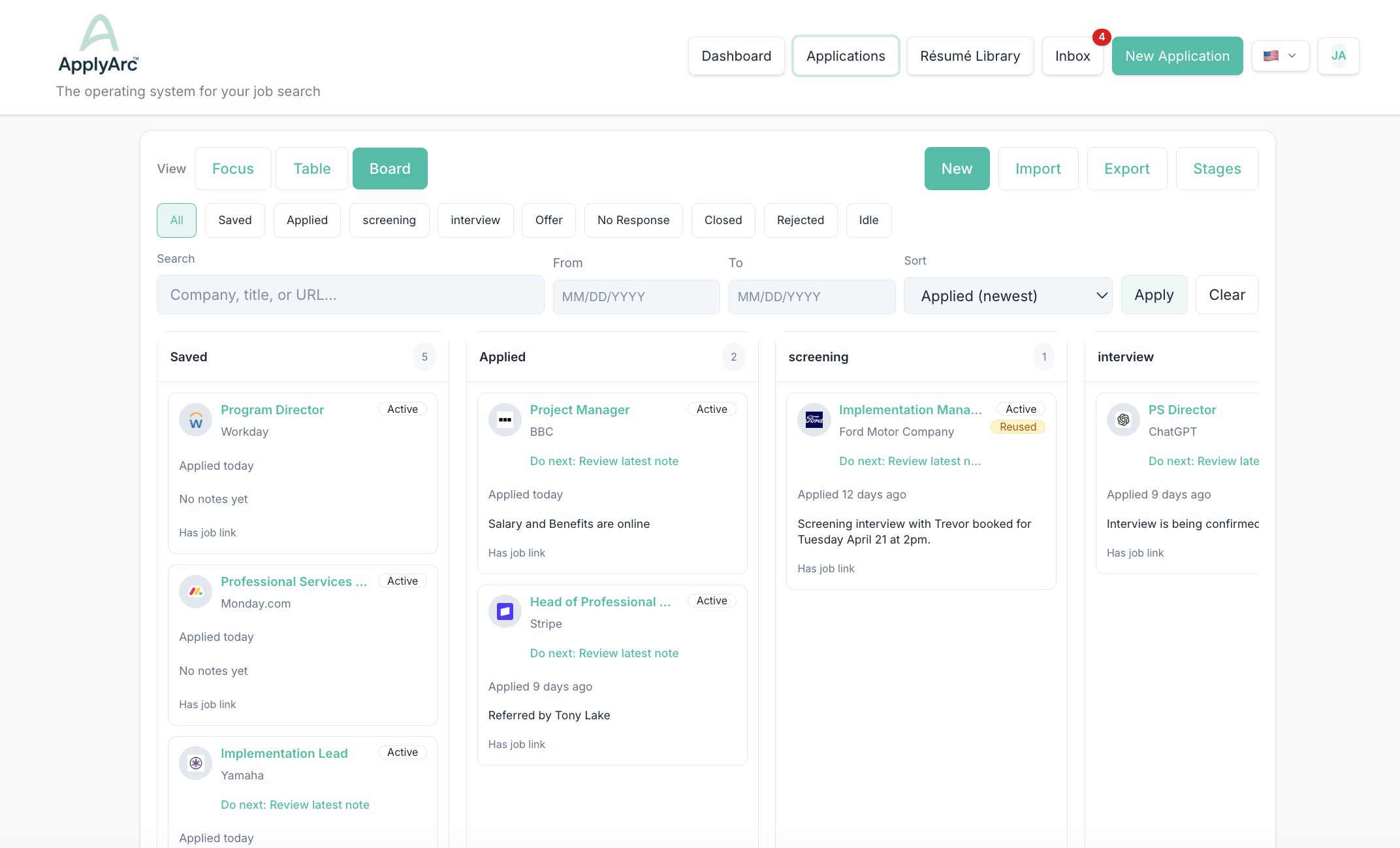
ApplyArc keeps the role, stage, dates, notes, and next action together. Select the screenshot to open the full-size view.